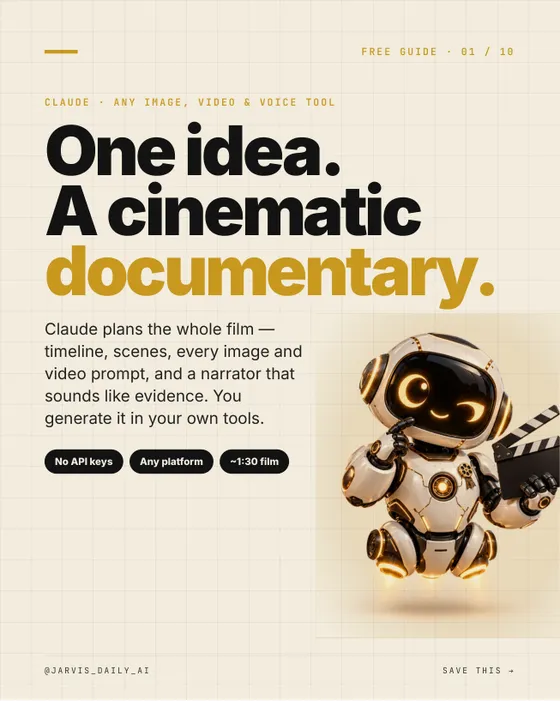
Make a cinematic AI documentary
One idea in. A whole documentary planned.
You get this PDF right away, plus one email a week with the new guide. Unsubscribe in one click. Privacy
The problem
AI video looks amazing for five seconds, then falls apart: faces change between scenes, the story wanders, the narrator sounds like an ad. Getting a long piece to hang together feels impossible.
After this guide
You'll turn a single idea into a full plan: timeline, scenes, every image and video prompt, characters and places locked so they match, and a cold, believable narrator script.
What's inside
- The four pillars of the style
- Locking characters and places so every scene matches
- Writing a cold, clinical narrator
- The full planning prompt
Free preview
This guide shows how to use Claude to plan a complete cinematic AI documentary of about 1:30 before you generate a single frame. Claude produces the timeline, scenes, image and video prompts, and a narrator script, and you generate the media in your own image, video and voice tools. It is for anyone who wants an AI film where every scene feels like the same documentary.
- Pick the scale of your storyChoose Incident Reconstruction for human-scale stories like an accident, disappearance or heist. Choose Large-Scale Investigation for geographic stories like a vanished aircraft or a search operation, or mix both.
- Lock your assets firstList everything that appears on screen and give each an ID and an image prompt: CHAR-01 for characters, LOC-01 for locations, PROP-01 for props. Generate each once and keep the best take, so scene three still looks like scene one.
- Build one 30-second take per sceneEach scene gets one continuous video prompt with the sound baked in and no voice in the clip. Each prompt also names which stills to attach.
- Write a cold, clinical narratorUse present tense, short declarative sentences, and at least one number per scene. Stay within the word budget: about 65 words for a 30-second block, 75 at most.
- End every scene on an open questionEach scene closes on a curiosity loop, and the film's big question is answered only at the end.
- Generate and editPaste each asset prompt into your image tool, attach the stills to each scene's video prompt, and record the narration in one take. Then edit with narration on top, clip audio underneath, and clock timestamps in the corner.
2 prompts from the guide
Make me a documentary about [your story]. Treat it as a real incident.
You are the planning department of a one-person documentary studio. Turn this idea into a complete production blueprint in one reply: [idea]. Treat it as a real incident. Give me: a case file (title, minute-by-minute timeline, chapters, scene table with clock times); asset image prompts with IDs; per scene a 30-second continuous video prompt with sound design and no voice, plus which stills to attach; a cold, clinical, present-tense narration within the word budget, ending each scene on an open loop; one master narration block and a voice card; an edit checklist.
The full guide has every step, all the prompts and the fixes for what usually goes wrong.
Questions
How do I make an AI documentary with Claude?
Give Claude one story idea and ask it to treat the story as a real incident. It returns a case file, asset image prompts, scene packs with video prompts, a narrator script and an edit checklist. You then generate the images, video and voice in your own tools.
Do I need API keys or a specific video tool?
No API keys are needed, and the guide works with any image, video and voice tool. It notes that Seedance-class models that accept references work best, and shorter-clip tools can split each block in two.
How do I keep characters and style consistent across scenes?
Lock your assets before making any video. Each character, location and prop gets an ID and a still image, and each scene's video prompt says which stills to attach. The video model gets the same references every time.
How long is the finished documentary?
The default is 3 scenes, about 1:30. If you ask for a longer runtime, Claude adds more scenes.
How should the narrator sound?
Cold, clinical and never selling, reading the case file into the record. It uses present tense, short sentences and no words like "shocking" or "tragic". The guide suggests a deep, neutral, low read, or your own voice clone, recorded once for the whole script.
More free guides
 Let AI edit your videos
 Turn a script into a neon promo film
 Your free AI production studio
 DramaClaw: script to finished film
 Text-to-Video Prompt Pack: make a clip by typing
 Keep your AI character the same in every shot