Kimi K3.1 Pro: Near-Opus Coding at Half the Price (and the Catch)

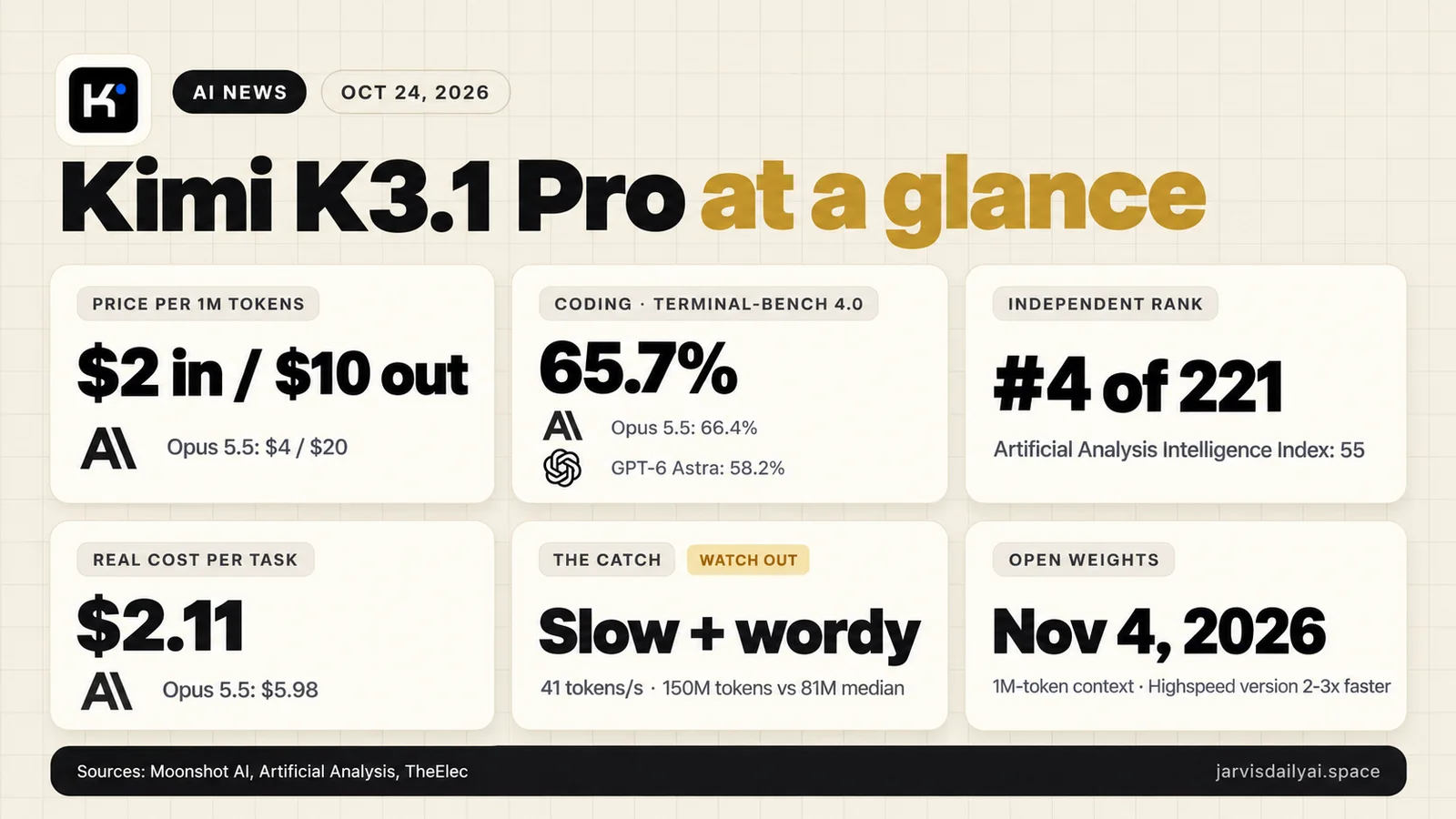
Moonshot AI released Kimi K3.1 Pro on October 24, and the first independent numbers are in. Artificial Analysis ranks it #4 out of 221 models on its Intelligence Index. That puts it ahead of OpenAI's GPT-6 Astra.
It costs $2 per million input tokens and $10 per million output tokens. That is half of what Claude Opus 5.5 charges.
So does the cheap model finally keep up with the expensive ones? On coding, nearly. But it is slow and it uses a lot of tokens, and both show up on your bill.
What is Kimi K3.1 Pro?
Kimi K3.1 Pro is Moonshot AI's newest large language model and the first of its K3.1 series. It is a post-trained version of Kimi K3, the model Moonshot shipped in July.
- Size: a mixture-of-experts model with 2.8 trillion parameters, of which 104 billion work on each token, according to TheElec.
- Memory: a 1-million-token context window, enough for a large codebase or a stack of reports.
- Two versions: K3.1 Pro, and K3.1 Pro Highspeed, which Moonshot says runs 2 to 3 times faster with the same skills.
- Open weights: Moonshot says the full model weights will be released by November 4, 2026. Then anyone can run it on their own servers.
Moonshot's pitch is coding, 3D work and finance. The benchmarks below show where that holds up.
How good is it?
On coding agents, it is close to the top. On Terminal-Bench 4.0, which tests agents doing real tasks in a terminal, Moonshot reports 65.7%. Claude Opus 5.5 scores 66.4% and GPT-6 Astra 58.2%. Artificial Analysis ran the test itself and measured 67.2%.
| Benchmark |  Kimi K3.1 Pro |  Opus 5.5 |  GPT-6 Astra |
|---|---|---|---|
| Terminal-Bench 4.0 (coding agents) | 65.7% | 66.4% | 58.2% |
| BenchCAD with tools (3D from images) | 92.7% | 96.2% | 95.9% |
| Kimi Hallu Bench Hard (errors, lower is better) | 8.3% | 15.0% | 5.5% |
Those three rows come from Moonshot's own blog, so treat them as the company's numbers. The independent ones point the same way:
- Intelligence Index: 55, ranked #4 of 221 on Artificial Analysis. GPT-6 Astra scores 53.
- Real work tasks: 1,846 Elo on GDPval-AA, 312 points above Kimi K3.
- Fewer made-up facts: on Moonshot's hardest hallucination test, the rate fell from 23.4% on K3 to 8.3%.
How much does Kimi K3.1 Pro cost?
The price per token is low. The official pricing page lists:
| Model | Input / 1M tokens | Output / 1M tokens |
|---|---|---|
| Kimi K3.1 Pro | $2 | $10 |
| Kimi K3.1 Pro Highspeed | $4 | $20 |
| Kimi K3 (previous) | $3 | $15 |
| Claude Opus 5.5 | $4 | $20 |
| GPT-6 Astra | $10 | $50 |
Cached input costs $0.20 per million tokens, and the price is the same across the whole 1M context. Kimi K3.1 Pro is a third cheaper than K3 and half the price of Opus 5.5.
What a task really costs is a better number. Artificial Analysis spent an average of $2.11 per task running its tests on Kimi K3.1 Pro. TheElec reports $5.98 per task for Opus 5.5 at maximum effort. That is still almost three times cheaper.
What is the catch?
It is slow, and it talks a lot. Artificial Analysis calls it "notably slow and very verbose."
- Speed: about 41 output tokens per second in Artificial Analysis's latest test. Long answers take a while.
- Length: it used 150 million tokens to finish the Intelligence Index, against a median of 81 million. You pay for every one of them.
- Thinking only: K3.1 Pro always reasons first. Kimi's docs say requests with thinking turned off get rejected.
- Trust: Anthropic, OpenAI and a White House adviser have accused Moonshot of training Kimi on Claude's answers (distillation). Moonshot has not responded, and China's embassy called the claims baseless.
The low price per token is real. For short tasks it stays cheap. For long agent runs, measure the total tokens, not the rate card.
What can you build with it?
Moonshot shows it doing work most chat models don't:
- Games and 3D: it builds games in Unity, Unreal and Godot, and 3D scenes in Three.js.
- 3D Make: describe an object on kimi.ai and download a model ready for a 3D printer.
- Blender and CAD: it writes and runs scripts to build and edit 3D parts without plugins.
- Finance: it scored 64.4 on OfficeQA Pro v2, a test of digging numbers out of real financial documents.
- Want to try 3D yourself? Our free guide shows one prompt that builds a living 3D world.
- Long jobs: in one test it built a walking simulator for a human skeleton, then tracked down and fixed 36 errors in the simulator's shoulder-muscle math.
How to try Kimi K3.1 Pro today
- In the browser or app: open kimi.ai or the Kimi app on iOS or Android.
- For coding: run Kimi Code and type
/model, then pick K3.1 Pro. Start a new session instead of switching mid-chat. - Through the API: use the model name
kimi-k3.1-proorkimi-k3.1-pro-highspeedon the Kimi API platform. Type the ID exactly. A wrong one falls back to an older model without thinking. - Test it on your own work: give it a task you already know the answer to, then compare the total tokens and the time with your current model.
Kimi's paid plans start at $15 a month (billed yearly) for Plus. The full 1M context in Kimi Code needs Pro or higher.
Should you switch?
If you run coding agents and pay per token, Kimi K3.1 Pro is the cheapest model near the top right now, and its weights open on November 4. If you need fast answers, try Highspeed or stay with what you have. Either way, test it on one real task before you move your work.
FAQ
Is Kimi K3.1 Pro free?
You can try Kimi K3.1 Pro on kimi.ai and in the Kimi app. Paid plans start at $15 a month, billed yearly, for Plus. The API costs $2 per million input tokens and $10 per million output tokens. The full open weights are promised for November 4, 2026.
Is Kimi K3.1 Pro better than Claude Opus 5.5?
Not quite on raw coding. On Terminal-Bench 4.0, Moonshot reports 65.7% for Kimi K3.1 Pro against 66.4% for Opus 5.5. It costs half as much per token, but it is slower and uses more tokens per task, so test both on your own work.
Is Kimi K3.1 Pro open source?
Moonshot calls it an open-weight model and says the full weights will be released by November 4, 2026. Until then you can use it through kimi.ai, the Kimi apps, Kimi Work, Kimi Code and the Kimi API.
What is Kimi K3.1 Pro Highspeed?
It is the same model running 2 to 3 times faster, according to Moonshot. It costs $4 per million input tokens and $20 per million output tokens, double the standard version, and it is included in Kimi's Pro plan and above.
How do I use Kimi K3.1 Pro in Kimi Code?
Open Kimi Code, type the /model command and select K3.1 Pro, ideally in a new session. It runs with thinking always on. The 1-million-token context in Kimi Code needs a Pro plan or higher.
Researched with AI, checked by a human. About the author